Edge Service Placement
Optimization and reinforcement-learning benchmarks for constrained service placement in edge-computing networks.
Constrained optimization
service-placement-benchmarks
Research benchmark
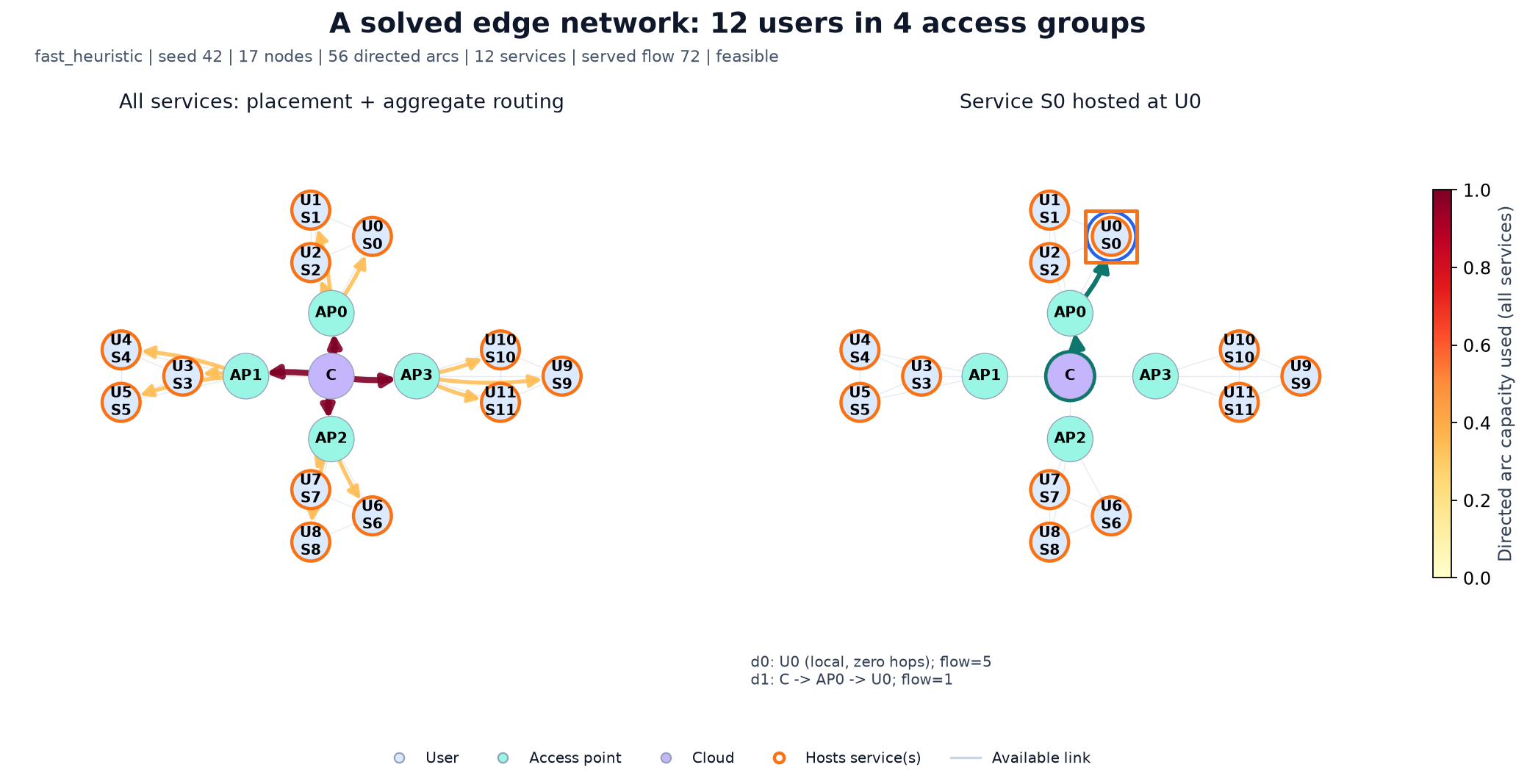
Compare edge-network service placement and routing strategies under compute, link-capacity, and latency constraints.
- Problem
- Edge networks must decide where to host services and how to route demand without violating resource or latency budgets.
- Approach
- A shared Python interface compares mathematical optimization, heuristics, evolutionary search, and reinforcement learning on the same network scenarios.
- Implemented
-
- Configurable synthetic tree and star networks; a common validator checks placement, routing, flow, capacity, resources, and latency.
- CSV exports record objectives, runtimes, feasibility, seeds, and errors; invalid candidates receive no objective score.
- Engineering
- Separate domain, solver, and reporting modules; optional solver dependencies; unit, integration, and regression tests; CI on Windows and Linux; CLI and Docker runner.
Scope. An evaluation toolkit. Connecting decisions to a live network requires a system-specific adapter; mathematical backends require Gurobi and a license.